Say what you do.
A dedicated service heading and specific details help customers find the right help. In this example, plumbing has its own page and estimate button.
Clear services. Real work. An easy next step.
Show customers what you do, give them real reasons to trust you, and make it simple to get in touch.
Your services and customers shape the pages. Here’s what that looks like in practice.
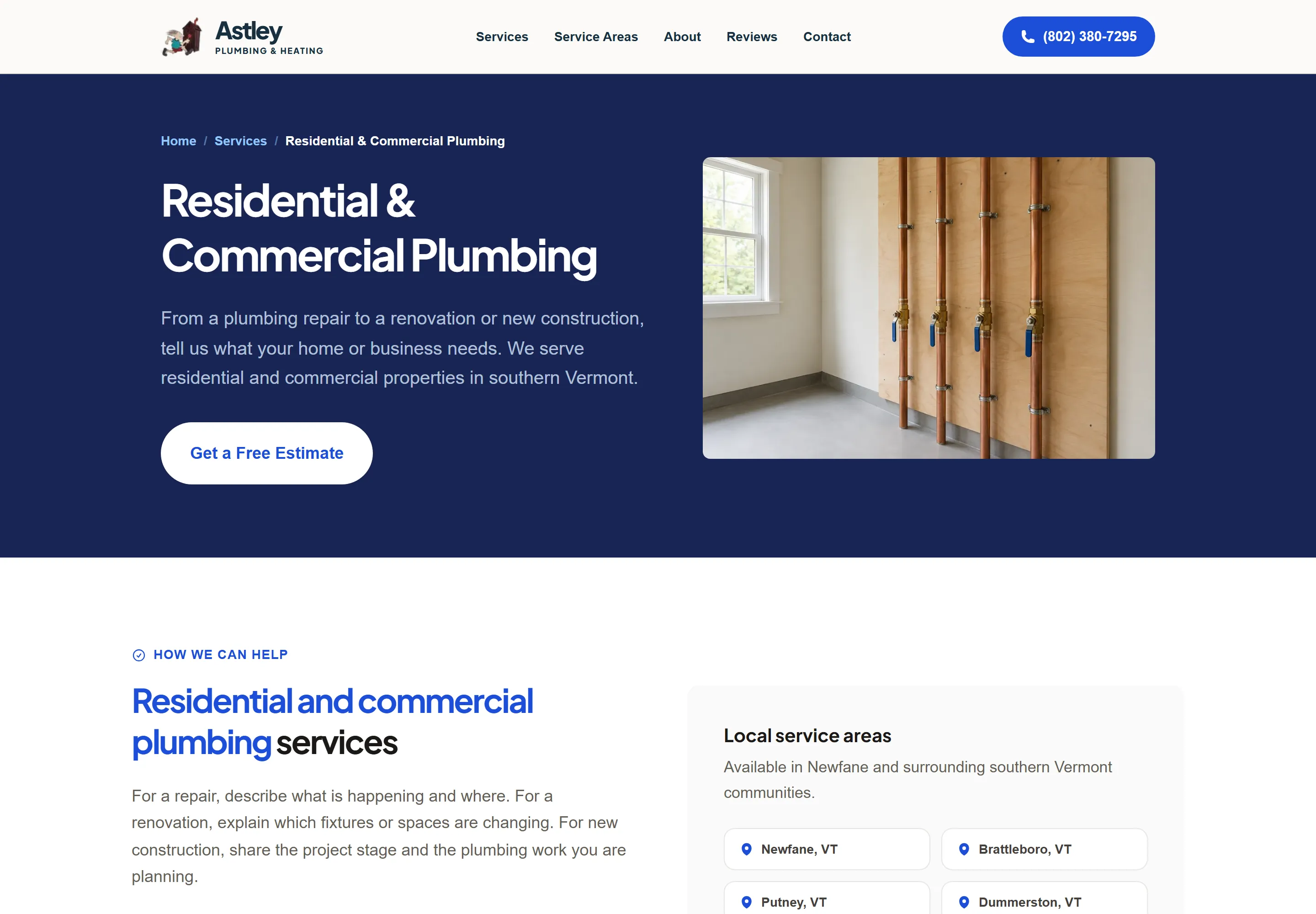
A dedicated service heading and specific details help customers find the right help. In this example, plumbing has its own page and estimate button.
Use accurate business details, your own work photos, and customer feedback you have permission to share. I plan space for your evidence; service imagery alone is not proof of completed work.
A clear call button. Readable service information. A form that fits the screen.
The Astley mobile design puts the phone number in a call button and the estimate form after the introduction. I test your contact path before launch.
See the full project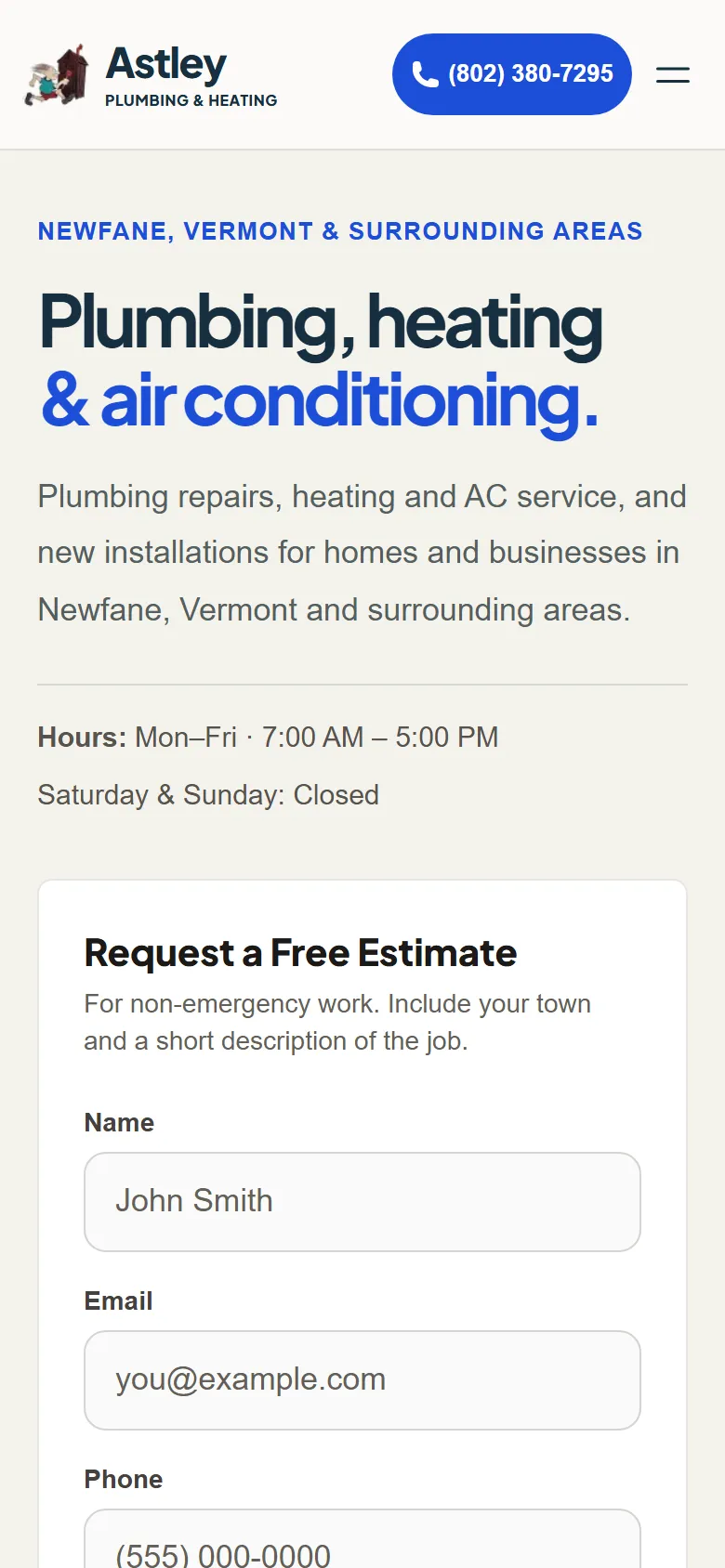
A managed website for the essentials, or a custom build for more involved needs.
$99/month
Billed monthly
$990/year
12 months for the price of 10. Paid upfront.
No separate website build fee
Your website, built and maintained.
By quote
For larger sites and added functionality, with scope and costs agreed before we start.
We start with your services, customers, service area, and the action visitors should take. Together we settle the page list and confirm what belongs in the build.
You supply accurate business details, photos, and any approved reviews. I organize the pages and design a site you can review, so corrections happen before it goes live.
Before launch, I check mobile layouts, navigation, links, and the standard inquiry form. Hosting and technical maintenance continue with the managed Website plan.
The managed Website plan includes hosting, technical maintenance, and help keeping your content current.
Send the text, photos, or business details you want updated. In-scope revisions are included, with a 48-hour turnaround.
Your website has a home, with technical maintenance handled as part of the plan.
Keep existing pages current with updated text, photos, and business information.
New pages, redesigns, and added functionality are quoted separately. Custom Website support follows your proposal.
Your first draft of the $99 Website plan is ready in 72 hours once I have your content, required access, and first payment, with the scope agreed. This is a working draft for your review; launch follows your approval and final checks. Custom projects have a separately agreed timeline.
Up to 9 pages, responsive design, hosting, technical maintenance, website SEO foundations, and a standard contact or estimate request form. There is no upfront build fee for this plan. Ecommerce and functionality beyond a standard inquiry form are outside its scope.
Accurate business facts, services, content sources, brand assets, photos you have permission to use, required account access, and one person to approve the work. I identify missing inputs before production begins.
The $99 Website plan includes unlimited revisions within your agreed website scope, completed within 48 hours of receiving your request. Updates to existing text, photos, and business details are included. New pages, redesigns, and new functionality are scoped separately. Custom website support is defined in your proposal.
Website SEO foundations include page titles, descriptions, sensible service-area language, and technical basics. Local SEO is a separate $399/month service per business location and Google Business Profile. It includes profile management, citations, reporting, and supported automations; it does not include an ongoing website content program.
For a larger website, additional functionality, or a more involved project. We assess the requirements and agree on the build fee, ongoing costs, deliverables, ownership, and handoff in your proposal before work starts. Ecommerce, memberships, portals, and integrations need individual feasibility review.
Yes. Prepay for 12 months of the Website or Local SEO plan and pay for 10: $990/year for Website (save $198), or $3,990/year per location for Local SEO (save $798). The annual charge is paid upfront. Voluntary cancellation does not prorate a prepaid term, subject to your agreement and applicable law. Monthly billing is also available. Custom Website pricing is agreed in your proposal.
Your domain, supplied content, and customer data remain yours. On the $99 Website plan, BearGorilla owns and manages the website design and code as part of the subscription; it is not an ownership transfer. Website files and migration are not automatically included; requests are handled individually. Ownership and handoff for custom projects are agreed in the proposal.
Cancellation stops your next renewal. Service continues through your paid period, then the managed website goes offline. Website files and migration are not automatically included. Voluntary cancellation does not prorate annual prepayment, subject to your agreement and applicable law. Custom projects have their own agreed terms.
Tell me what you do, where you work, and what you need your website to help with.